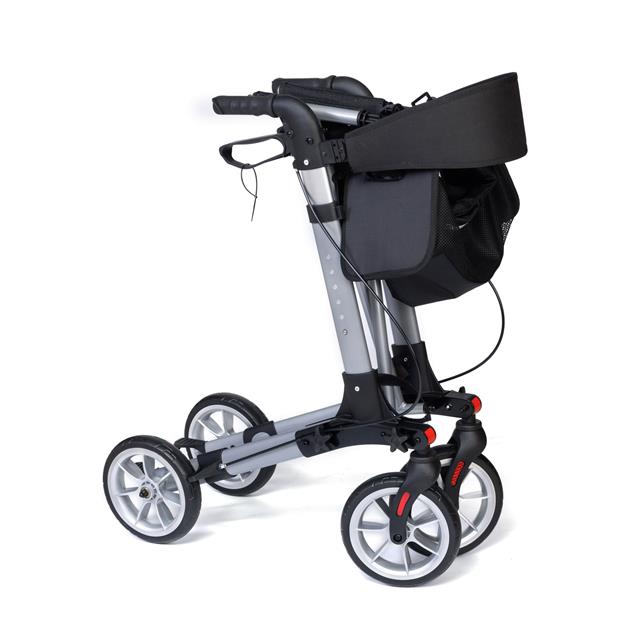
Mobility aids should provide freedom. They should never feel like physical burdens. Yet, for individuals relying on a mobility aid, the physical weight of a rollator dictates daily independence. You notice this weight when navigating urban curbs. You feel it sharply when lifting the device into a vehicle. Buyers frequently face a frustrating dilemma. They must choose between standard aluminum models and premium carbon fiber upgrades. Many shoppers struggle to determine if the significant price jump makes sense. They wonder if the premium cost is structurally and functionally justified.
We are here to provide clarity. This article delivers an evidence-based, skeptical evaluation of both materials. We look past the flashy marketing claims. You will explore real-world durability, vibration mechanics, and the actual return on investment for weight savings. By understanding how these materials perform under stress, you can make a confident, personalized choice for your daily mobility needs.
Key Takeaways
An aluminum rollator provides the most reliable balance of durability, heavy-duty weight capacity, and cost-effectiveness, making it the industry standard for 80% of users.
Carbon fiber models excel in extreme weight reduction and vibration dampening, ideal for users with severe lifting limitations or those navigating cobblestone/uneven urban environments.
The decision should be based on the "Trunk Lift Test"—evaluating whether the specific user's upper body strength requires the 2–4 lb weight reduction that carbon fiber offers, justifying the premium cost.
Unlike metal, carbon fiber is prone to catastrophic failure if deeply scratched or crushed, requiring more careful handling during travel.
Defining the Baseline: Structural Realities of Rollator Materials
The Steel Baseline
Medical equipment manufacturers relied heavily on steel for decades. We must briefly establish steel as the ultimate historical baseline. Steel frames are the heaviest option available. They often weigh 20 pounds or more. They are also the cheapest to manufacture and the most robust against physical abuse. Today, steel is used primarily for standard bariatric needs where maximum load-bearing capacity takes priority over portability.
The Shift to Lighter Alloys
Modern medical equipment eventually shifted away from heavy steel construction. Users needed to lift their devices. They needed independence. Aluminum quickly took over the market. Today, aluminum serves as the undisputed baseline for lightweight mobility. Manufacturers can mold and shape it easily. Meanwhile, carbon fiber represents the premium, ultra-lightweight tier. Aerospace technology introduced carbon fiber to the medical field. It offers incredible strength at a fraction of traditional weights.
Material Physics in Mobility
Material choice impacts three vital daily factors. You experience these physical realities every time you step outside.
Gross Physical Weight: This determines how easily you can push the device uphill or lift it over obstacles.
Shock Absorption: This measures how well the frame handles vibrations from uneven terrain. Better absorption means less arm fatigue.
Thermal Conductivity: This determines how cold the frame gets in winter. Metals pull heat from your hands. Composites do not.
Below is a quick reference table comparing the physical traits of these three core materials.
Material
Average Weight
Shock Absorption
Thermal Feel (Winter)
Steel
20+ lbs
Low
Very Cold
Aluminum
14 - 18 lbs
Moderate
Cold
Carbon Fiber
10 - 12 lbs
High
Neutral
Evaluating the Aluminum Rollator: The Industry Standard
Structural Integrity & Predictable Wear
Engineers value aluminum for its ductility. An aluminum frame bends or dents before it breaks entirely. This predictable wear pattern acts as a safety feature. You can haphazardly throw the device into a car trunk. You might accidentally drop it down a flight of stairs. The metal might scratch or dent. However, it rarely compromises the structural safety of the user. You can see the damage and know the frame remains largely intact.
Cost-to-Performance Ratio
High-grade aluminum offers a lightweight profile at a fraction of the cost of composites. Most modern units typically weigh between 14 and 18 pounds. This weight range is manageable for the vast majority of seniors and mobility-impaired individuals. When you choose a well-engineered Aluminum Rollator, you gain a highly capable, reliable walking aid without depleting your savings. The value proposition here remains unmatched in the medical equipment industry.
Heavy-Duty Scaling
Aluminum frames are highly adaptable. Engineers can easily modify them for high-weight capacities. Bariatric models routinely support 300 to 500 pounds. Manufacturers achieve this by slightly increasing the tubing thickness. They add cross-bracing for lateral support. Remarkably, these heavy-duty models do not become unmanageable. They retain a relatively low gross weight while delivering massive structural support.
Drawbacks
We must acknowledge the physical limitations of metal. Aluminum transmits surface vibration directly to the user. When you roll over gravel or brick pavers, the front wheels hit the bumps. The kinetic energy travels up the metal forks. It moves through the frame. Finally, it reaches your hands and arms. This continuous micro-vibration can accelerate upper body fatigue over long distances. Users with severe wrist arthritis may find this trait uncomfortable.
Carbon fiber presents one primary value proposition. It drives the total device weight down to the absolute minimum. Premium models often weigh a mere 10 to 12 pounds. This extreme weight reduction changes the daily experience entirely. Users who previously struggled to push a walker uphill suddenly find themselves moving freely. The physical effort required to initiate movement drops significantly.
Vibration Dampening Mechanics
Carbon fiber possesses inherent vibration dampening properties. The material consists of woven fibers suspended in a hardened resin. This composite structure naturally absorbs micro-shocks. It acts like a sponge for kinetic energy. When you hit a bump, the frame diffuses the impact before it reaches the handlebars. This engineering trait reduces strain on the user's wrists, elbows, and shoulders. It is a massive benefit for chronic pain sufferers.
Thermal Advantages
We rarely consider temperature when buying medical equipment. Yet, thermal conductivity matters. Aluminum pulls heat away from warm skin. In freezing weather, metal frames become painfully cold to the touch. Carbon fiber offers a minor but highly practical benefit here. The composite material remains temperature-neutral. It will not freeze your hands if you leave the device in a cold car overnight.
Implementation Risks (The Skeptical View)
You must understand the fragility of the resin matrix. We must take a skeptical view of marketing promises. Carbon fiber is incredibly strong under direct, predictable loads. It easily holds a 300-pound person sitting on the seat. However, it performs poorly against sharp lateral impacts. The material can crack or splinter if struck from the side. Imagine getting the frame crushed under a heavy suitcase in an airplane cargo hold. Such impacts cause catastrophic structural failure. Once the carbon strands snap, the frame loses all integrity.
Key Evaluation Dimensions: Cost vs. Weight ROI
The Weight ROI Calculation
We need a logical framework for evaluating the price difference. Carbon models carry steep premium price tags. Let us look at the return on investment (ROI) regarding physical weight. Assume an aluminum model costs $150 and weighs 15 pounds. Assume a comparable carbon model costs $450 and weighs 12 pounds. You pay an extra $300 to save 3 pounds. Essentially, you are paying $100 per pound saved. You must ask yourself if your physical condition requires spending $100 for every pound you remove.
The "Trunk Lift" Threshold
You should frame this weight difference around your most common failure point. For most people, this is the trunk lift. Independence often fails at the car bumper. If you cannot lift your mobility aid into your vehicle, you cannot travel alone. Evaluate your upper body strength honestly.
Find a household object weighing exactly 15 pounds.
Attempt to lift it from the ground to waist height.
Observe your shoulder and lower back strain.
Repeat the process with a 10-pound object.
If you can lift the 15-pound object comfortably, the premium upgrade may not be necessary. If the 15-pound object causes pain, the ultra-light frame becomes a vital necessity.
Lifespan and Maintenance Realities
You must compare maintenance and replacement realities before making a purchase. A high-quality metal frame is essentially a lifetime purchase. You might replace the wheels or the brake cables over time. However, the core frame survives drops, scrapes, and trunk slams. A dented metal tube still functions safely. Carbon frames do not share this resilience. A damaged carbon frame typically requires a full replacement. You cannot easily repair splintered carbon fibers. One unfortunate drop onto sharp concrete can ruin an expensive investment.
Implementation Scenarios: Matching Material to Daily Routines
Scenario A: The Frequent Traveler (Air & Transit)
Some users travel frequently. They take airplanes, trains, and cruise ships. We strongly recommend aluminum for users checking their devices into cargo holds. Baggage handlers work quickly. They toss items. They stack heavy suitcases on top of fragile medical equipment. A carbon frame faces a high risk of cracking under these chaotic conditions. A reliable Aluminum Rollator easily survives rough transit handling. It might suffer cosmetic scratches, but it will safely support you when you land.
Scenario B: The Solo Urban Commuter
Consider the solo city dweller. This user navigates curbs, subway stairs, and public transit daily. They live in an apartment and manage their mobility alone. They possess lower physical strength due to age or illness. For this specific scenario, we highly recommend carbon fiber. The user must constantly lift the device over thresholds. The vibration dampening also proves invaluable on uneven city sidewalks and brick paths. The extreme weight reduction directly translates to increased daily stamina.
Scenario C: All-Terrain & Outdoor Use
Many users love the outdoors. They want to walk on grass, dirt trails, and gravel paths. Marketing campaigns often push ultra-light models for outdoor adventures. We disagree. For rough, off-road terrain, physical weight actually provides better grounding. Extra mass gives the frame stability. It prevents the device from bouncing erratically over rocks. An ultralight carbon frame can feel skittish on loose gravel. It lacks the downward force needed to dig into the terrain. Therefore, metal models perform better as stable, all-terrain companions.
Conclusion
Choosing the right mobility aid requires a balance of physics, budget, and physical reality. We can draw clear, actionable conclusions from evaluating both materials. An aluminum frame remains the most logical, durable, and cost-effective choice for the vast majority of users. It handles daily abuse beautifully while remaining reasonably lightweight. Carbon fiber stands as a specialized tool rather than a universal necessity.
You should consider a few vital next steps before completing your purchase:
Assess your true lifting limit: Perform the physical trunk lift test with household weights to find your pain threshold.
Evaluate your travel habits: Choose metal if you frequently hand your equipment over to airline baggage crews.
Upgrade only for strict limitations: Invest in carbon fiber only if severe arthritis or post-surgery weakness makes those 3 pounds the barrier between staying home and going out.
Consider terrain stability: Remember heavier frames track better on dirt and gravel.
FAQ
Q: Are aluminum rollators heavy?
A: No. This is a common misconception carried over from old steel walkers. Modern aluminum models utilize lightweight tubular engineering. They typically weigh a very manageable 14 to 18 pounds. Most adults can comfortably push and lift them without extreme exertion.
Q: Can carbon fiber rollators support bariatric weight limits?
A: Carbon fiber is inherently strong under static loads. However, most manufacturers avoid using it for bariatric models. High weight-capacity units usually utilize reinforced aluminum or steel. This choice ensures maximum structural safety against lateral forces while keeping manufacturing costs under control.
Q: Do aluminum rollators rust?
A: Aluminum does not rust like steel does. Steel contains iron, which oxidizes into red rust. Aluminum forms a hard, microscopic oxide layer when exposed to air. This layer actually protects the metal from further corrosion. Your device is highly weather-resistant and safe for rainy environments.
Q: Is the price difference for carbon fiber covered by insurance/Medicare?
A: Generally, no. Standard insurance and Medicare prioritize medical necessity over premium comfort. They will usually cover the cost of a standard lightweight metal device. They view the ultra-lightweight composite materials as luxury upgrades. You will likely pay the price difference entirely out of pocket.
Ralon Medical And Science Co., Ltd. with sets of overseas equipment, we have a Plastic Plant, a Steel Tubes Plant, a Hardware Plant. Also, a Product Testing Center. Special specification can be produced according to customers' designs or samples.